Everything feels like too much right now.
Your to-do list keeps growing. Your mind won’t quiet. Your body feels tense. You might be moving through your days in constant rushing, trying to keep all the plates spinning, wondering when you’ll finally catch your breath. Perhaps work feels particularly stressful right now, or you’re simply carrying too much across all areas of life.
Here’s what we want you to know: You’re not failing. You’re not weak. You may simply be disconnected from the ground beneath your feet—from your center, your breath, and the present moment where peace actually lives. If overwhelm has you questioning your path or purpose, you’re not alone in that experience either.
In 1970, Louise Hay discovered at the First Center of Religious Science a principle that changed her life: the present moment is the only point of power. When we’re feeling overwhelmed, we’re often living everywhere except now, replaying yesterday’s mistakes, rehearsing tomorrow’s worries, carrying responsibilities that may not even be ours.
Download Your Guide
Includes grounding practices, mindfulness exercises, and daily reflections
Offered openly.
You’re Not Drowning, You’re Disconnected from Ground
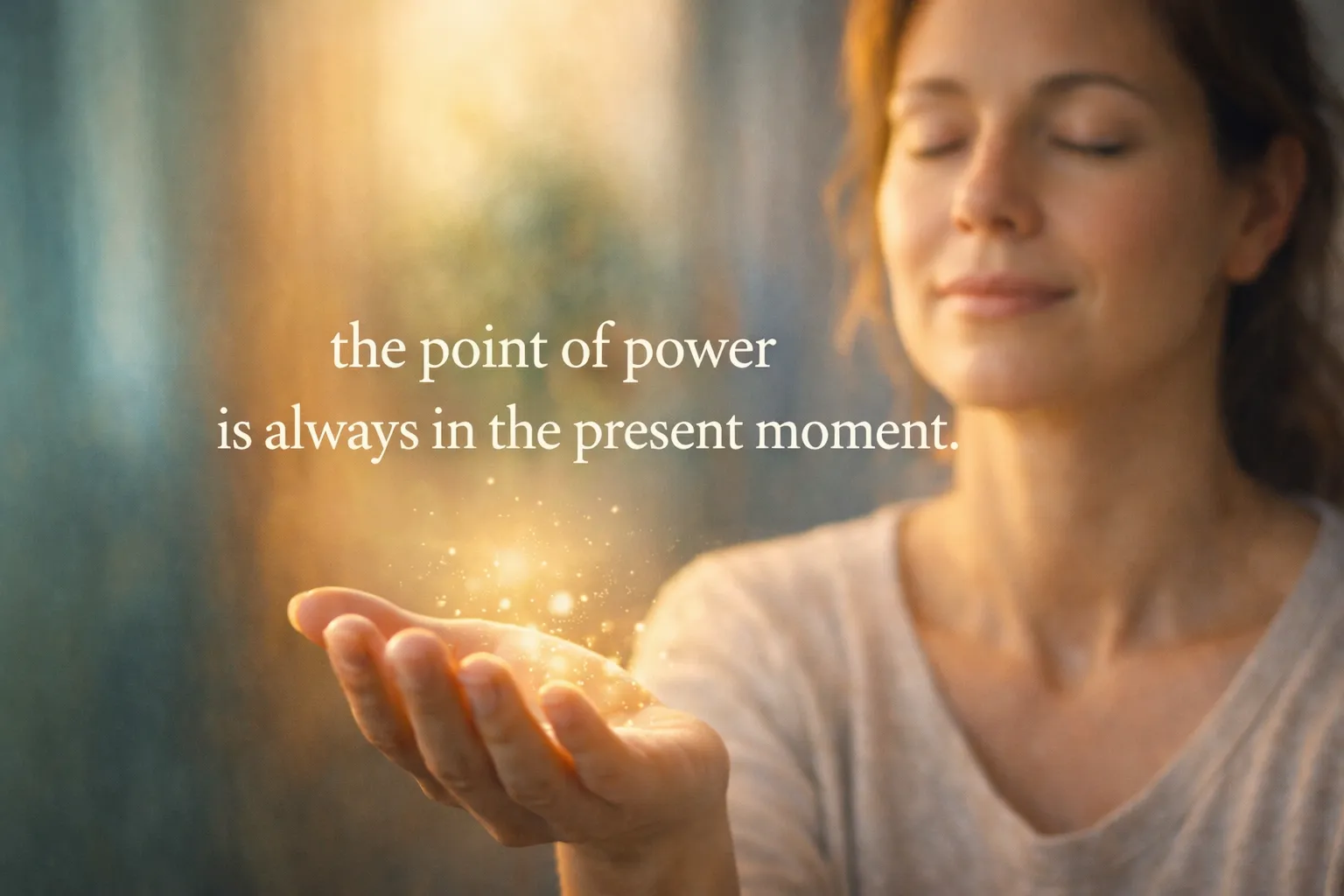
Ernest Holmes, founder of Religious Science, taught that “the point of power is always in the present moment.” Overwhelm happens when your awareness scatters across past and future, when you lose connection with your body, and when you forget you can return to now. When overwhelm deepens into mental exhaustion and burnout, these practices become even more essential.
These aren’t signs that something is wrong with you. They may be invitations to come back to your body, back to your breath, back to this single moment.
Raymond Charles Barker, who served at First Center of Religious Science, often reminded people: “There is no time. There is only now.” When you’re feeling overwhelmed, you don’t have to carry all of time at once. You only have to be here, now, in this breath.
Mindfulness Practices for Emotional Stability
Mindfulness isn’t about emptying your mind or achieving perfect calm. It’s about returning your awareness to the present moment—again and again, with compassion for yourself when you notice you’ve drifted.
The 5-4-3-2-1 Grounding Practice
When feeling overwhelmed, try this mindfulness exercise to anchor yourself in the present:
Notice and name:
- 5 things you can see (corner of your desk, light on wall, your hands)
- 4 things you can physically feel (feet on ground, chair supporting you, air on skin)
- 3 things you can hear (distant traffic, fan humming, your breath)
- 2 things you can smell (coffee, fresh air, nothing at all—that counts too)
- 1 thing you can taste (lingering flavor, or simply the taste of your mouth)
This simple mindfulness activity gently interrupts the overwhelm spiral by returning your attention to sensory reality. You can’t be fully overwhelmed and fully present at the same time.
Three-Breath Reset
Louise Hay learned at First Center: “The breath is the bridge between mind and body.” When you’re feeling overwhelmed, your breath becomes shallow or you might hold it entirely without realizing.
Try this mindfulness meditation:
- Stop what you’re doing completely
- Place one hand on your heart, one on your belly
- Take three full breaths:
- Inhale slowly for 4 counts
- Hold gently for 4 counts
- Exhale completely for 6 counts
- Notice how you feel different after just three conscious breaths
You might practice this mindfulness exercise throughout your day—before meetings, after difficult conversations, or whenever you notice tension building.
How to Calm Your Nervous System Naturally
Your nervous system responds to overwhelm with activation—preparing you to fight, flee, or freeze. Learning how to calm your nervous system naturally gives you practical tools to shift from activation back to regulation.
Vagal Tone Reset
The vagus nerve is the main pathway of your parasympathetic nervous system—your “rest and digest” mode. When you’re feeling overwhelmed, your vagus nerve may need support to calm nerves and anxiety.
Simple vagal toning practices:
Humming or Singing – The vibration stimulates the vagus nerve. Try humming a favorite song for 1-2 minutes. You might feel your body soften.
Cold Water on Face – Splash cold water on your face or hold a cold cloth to your forehead for 30 seconds. This activates the “dive response” which can help calm your nervous system naturally and quickly.
Gentle Neck Stretches – The vagus nerve runs through your neck. Slow, gentle neck rolls can help calm nerves physically.
Grounding Through Movement
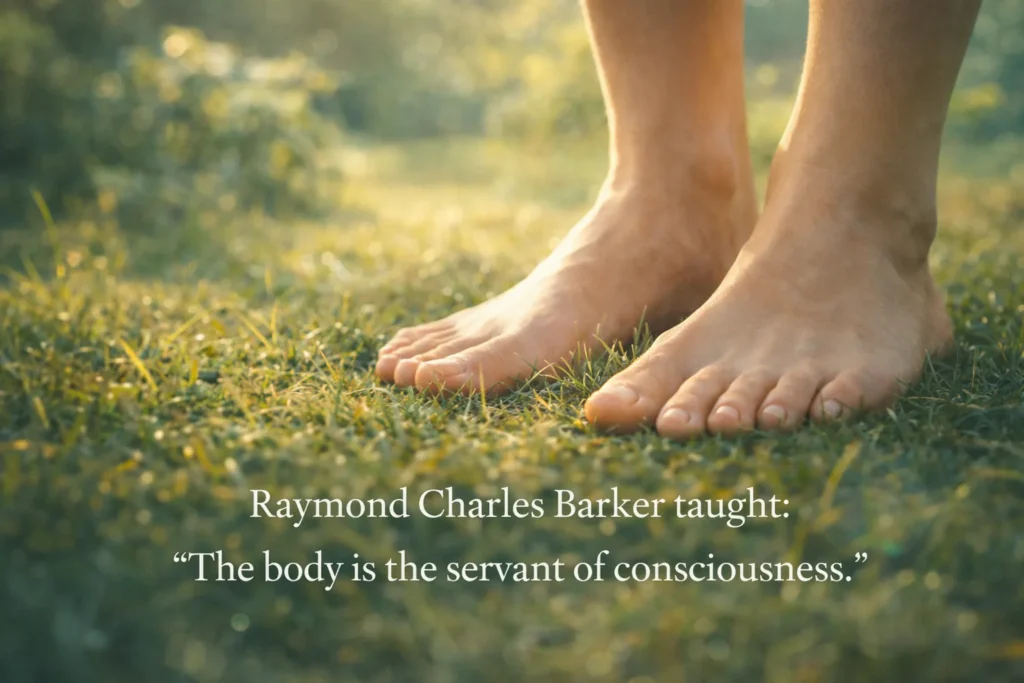
Raymond Charles Barker taught: “The body is the servant of consciousness.” When your mind feels overwhelmed, sometimes you need to move your body to shift your state.
Barefoot Earth Connection – Stand barefoot on grass, soil, or sand for 5-10 minutes. Feel the earth supporting you. Research shows direct earth contact can help calm your nervous system and reduce stress.
Shaking Practice – Animals naturally shake to release stress and calm nerves after threat. Stand with soft knees and gently shake your whole body for 1-2 minutes.
Breath Patterns to Calm Nerves
Your breath directly influences your nervous system. By consciously changing your breath pattern, you can signal your nervous system that it’s safe to settle.
4-7-8 Calming Breath:
- Breathe in through your nose for 4 counts
- Hold your breath for 7 counts
- Exhale completely through your mouth for 8 counts
- Repeat for 4-8 rounds
The extended exhale signals safety to your nervous system and can help calm nerves and anxiety naturally.
Building Your Inner Peace Practice
Louise Hay discovered at First Center of Religious Science: “Peace begins with me.” Not with changed circumstances, not when everything is finally handled, but with the choice to return to center—right here, right now.
When Overwhelm Rises
When you notice overwhelm building during your day, you might try:
- Name it: “I’m feeling overwhelmed right now”
- Stop moving: Literally pause what you’re doing
- Ground physically: Feel your feet, soften your jaw, drop your shoulders
- Three breaths: Return to your body through breath
- Choose one thing: What is the single next right action?
You don’t need to solve everything. You just need to return to now and take one conscious step.
The Sacred No
Sometimes feeling overwhelmed is your inner wisdom telling you: “This is too much.” When you’re feeling overwhelmed, you might ask:
- What am I carrying that isn’t actually mine to carry?
- Where am I saying yes when I mean no?
- What could I release or simply stop doing?
Your no creates space for your yes to be genuine. Your boundaries aren’t selfishness—they’re self-preservation.
You’re Not Alone in This
At First Center of Religious Science, we’ve sat with many people who arrived feeling exactly as you might feel now—scattered, exhausted, overwhelmed. Sometimes overwhelm comes with a deep sense of isolation, a loneliness that feels like more than just being alone. And we’ve watched those same people learn to return to ground, to breath, to the present moment where peace lives.
Louise Hay walked this path in 1970. She learned that external circumstances don’t have to control internal state that we can choose, in each moment, to come back to center. That teaching touched millions of lives. Your journey toward ground matters just as much.
You don’t need to fix yourself. You might simply need to remember: you can return to your breath, to your body, to this moment. As many times as needed. That’s not weakness that’s wisdom.
A Moment to Return to Ground
“If you’re still reading this while your nervous system feels activated and your mind won’t settle, it means you’re looking for a way back to solid ground.”
You don’t have to find your way back entirely on your own.
These grounding practices help you reconnect with the present moment. But sometimes, what an overwhelmed nervous system truly needs is not just another technique to practice alone—it needs a calm, supportive space where you can simply soften, breathe, and be held without pressure to perform or fix yourself.
Louise Hay discovered this truth at First Center of Religious Science: healing overwhelm isn’t only about what you do in isolation. It’s also about placing yourself in environments where your nervous system can finally rest, where mindfulness isn’t something you force, but something you receive.
For over 80 years, First Center of Religious Science has offered gentle gatherings specifically designed for people whose minds won’t quiet, whose bodies won’t settle, and whose spirits are tired of carrying everything alone.

💙 Thursday Louise Hay Self-Healing Gathering (7:00 PM ET)
This is not another task to add to your overwhelmed schedule. This is a spacious, gentle environment where you can arrive scattered and leave more grounded without having to ‘get it right.
In this guided gathering, you’ll experience:
• Louise Hay’s mirror work for rebuilding your self-love foundation
• Gentle practices to quiet the inner criticism that drains energy
• Consciousness-based techniques for emotional and spiritual replenishment
• A compassionate environment where rest and healing are encouraged
You don’t need to prepare anything.
You don’t need to feel “ready.”
You can simply come, sit, listen, and receive.
Stay Connected: Weekly Wisdom Delivered
Want these consciousness-shifting principles delivered to your inbox each week?
Subscribe to the FCRS Newsletter and receive:
- Weekly spiritual teachings from Dr. Greg Harte
- Practical affirmations for workplace calm
- Community stories of transformation
- Exclusive resources and guided practices
- Early access to special events and classes